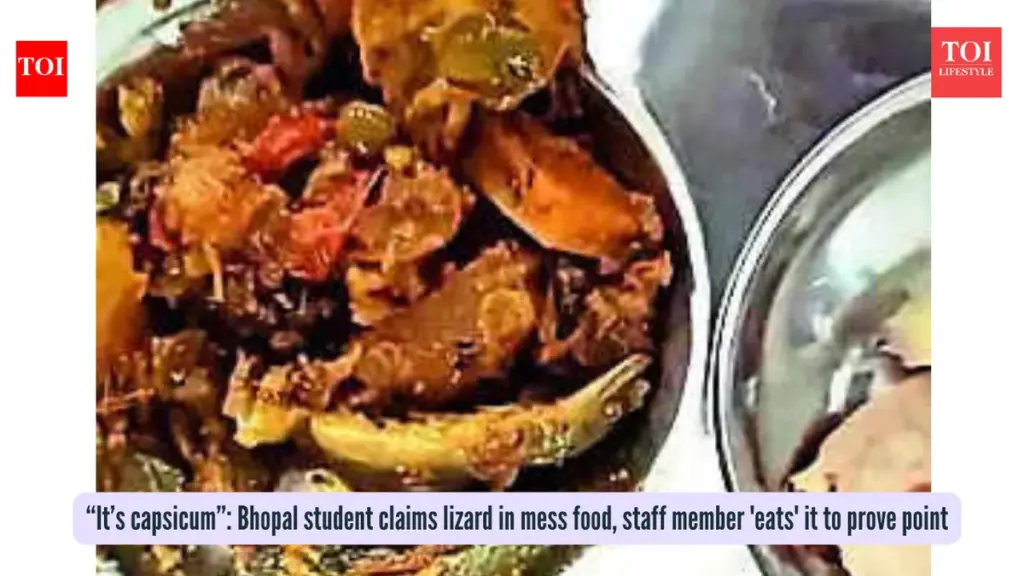
A student at RGPV alleged he found a lizard in his hostel meal, leading to a viral video and an investigation by the university.
Hostel food often becomes a topic of debate regarding hygiene, trust, and accountability. Recently, a student at the University Institute of Technology, RGPV, in Bhopal, India, claimed to have found a lizard in his meal. This alarming assertion has raised concerns about food safety in university hostels.
The situation escalated when a staff member from the mess insisted that the object in question was merely capsicum, or ‘Shimla mirch’ as it is known locally. To prove his point, the staff member even consumed the item, a move that many found questionable. The incident was captured on video and quickly went viral on social media, drawing widespread attention.
The student, however, stood firm in his claim, stating, “Bhai saab, yeh kya hai, dekh lo,” which translates to “Brother, what is this, take a look.” He described the object as having a lizard’s eye, further intensifying the controversy. In response to the claims, the canteen operator denied any wrongdoing, maintaining that the item was indeed capsicum.
RGPV Director Sudhir Bhadoria has assured students that their health would not be compromised. He stated that a committee has been formed to investigate the matter thoroughly. Bhadoria emphasized that strict action would follow if any negligence is found during the inquiry.
As the investigation unfolds, observers are keen to see how the university will address the allegations and what measures will be implemented to ensure food safety in the future. The incident has sparked discussions about the quality of food provided in hostels and the accountability of food service providers.
Details remain unconfirmed regarding whether the object was actually a lizard or capsicum. The outcome of the investigation may have significant implications for food safety protocols at RGPV and similar institutions in India.
In a humorous take on the situation, some social media users remarked, “When your defence strategy is literally to ‘eat’ the crime scene.” This incident not only highlights the serious issue of food safety but also the lengths to which individuals may go to defend their claims.