Spain clinches their second FIFA World Cup title, defeating Argentina 1-0 in extra time. Ferran Torres scored the winning goal in the 106th minute. Read more!
Spain claimed their second FIFA World Cup title after a dominant performance against defending champions Argentina in the final. The match, held at the New York New Jersey Stadium, saw Spain secure a 1-0 victory in extra time, with Ferran Torres scoring the decisive goal in the 106th minute.
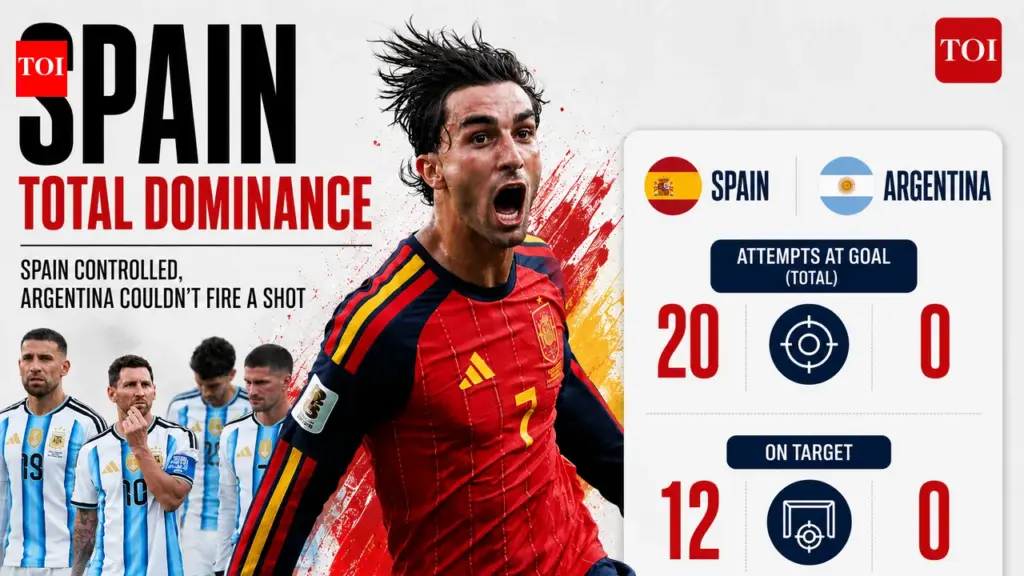
The scoreline, however, did not fully reflect Spain’s control over the game. Spain exhibited a masterclass in football, maintaining control of the ball, space, and tempo throughout the match. They unleashed 20 shots, with 12 on target, and completed 738 of their 817 passes. Argentina, in contrast, failed to register a single shot in regular time.
Spain’s Tactical Superiority
Spain’s midfield, orchestrated by Fabian Ruiz and later Pedri, dictated the rhythm of the game. Players like Alex Baena and Rodri consistently found openings between Argentina’s lines, while Dani Olmo, and later Nico Williams Jr and Lamine Yamal, stretched the pitch with their wide play. Argentina spent much of the match retreating and defending.
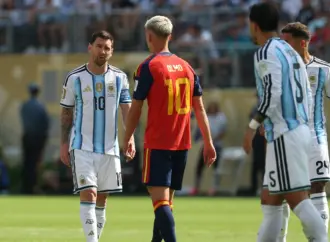
Lionel Messi, who had been instrumental in Argentina’s journey to the final, found himself isolated. Every touch he made was met by Spanish players, and passing lanes were consistently closed off, preventing him from imposing his rhythm on the game. This made it one of his quietest appearances in a World Cup match, as Spain effectively prevented the contest from being played on his terms.
Argentina’s inability to escape their own half was a clear indicator of Spain’s control. The South American side finished the 90 minutes with only 34% possession, their lowest share of the ball in any World Cup match since Opta began recording such statistics in 1966.
Goalkeeper Emiliano Martínez had the most touches for Argentina, highlighting how effectively Spain pinned back the reigning champions. Martínez made several outstanding saves, denying opportunities from Williams, Pedri, and Torres, and repeatedly frustrating Spain’s attacks.
However, even Martínez could not hold out indefinitely. In extra time, Williams cushioned a header to Torres, who then fired past the goalkeeper to secure Spain’s victory. Argentina’s hopes were further diminished when Enzo Fernández received a red card in stoppage time, reducing Lionel Scaloni’s side to 10 men.
Post-Match Reactions and Celebrations
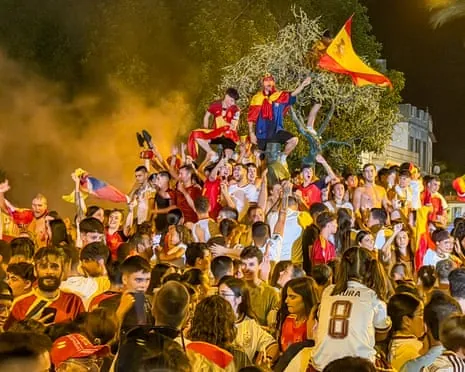
Following their victory, the Spain squad is scheduled to land in Madrid around 2pm local time. They are expected to be received at the Royal Palace and the Prime Minister’s residence, and will participate in an open-top bus parade through the capital.
However, celebrations in western Spain were marred by a tragic incident. A 13-year-old died and two others were injured when a fountain partially collapsed in Ciudad Rodrigo during the early hours of Monday. Hundreds of residents had gathered at the Arbol Gordo fountain when the upper part of the monument broke loose. The town hall of Ciudad Rodrigo expressed condolences, stating that what should have been a celebration turned into a tragedy.
The final match itself was described by some as a display of complete domination by Spain. One analysis noted that Argentina took a total of zero shots at goal during the first 117 minutes of the final. The triumph was attributed to Spain’s collective superiority, with Luis de la Fuente’s side controlling possession, dictating territory, and suffocating Argentina’s offensive attempts.
For Argentina, the defeat marked the end of their reign that began in Qatar four years prior. The match will be remembered not for individual brilliance from Argentina, but for Spain’s rare and complete domination.
Among the Spanish players, Pau Cubarsi, a 19-year-old who debuted at 16, was highlighted for his exceptional nous, composure, and ability on the ball as a centre-back. Pedro Porro was also noted for his maturity into a fine all-round right-back. Nico Williams’ journey to becoming a world champion was also highlighted, with his parents having left Ghana and crossed the Sahara in search of opportunities.
The 2026 World Cup final will be remembered for Spain’s tactical mastery and overwhelming control, culminating in their second title.
Read Also
Source: theguardian.com