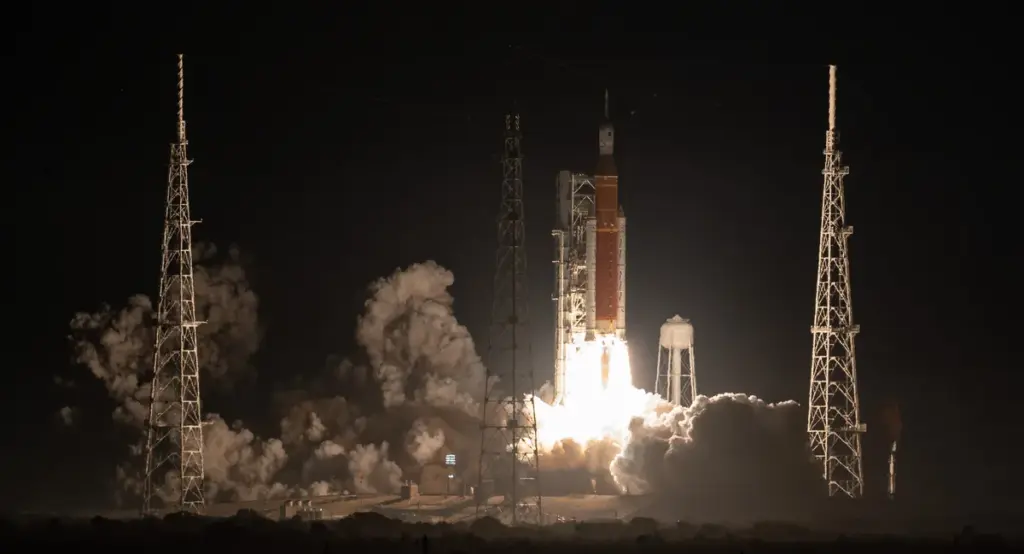
NASA’s Artemis II mission, scheduled for April 2026, will be the first crewed mission to the Moon since Apollo 17 in 1972.
The upcoming NASA Artemis II mission, slated for launch on April 1, 2026, represents a pivotal moment in human space exploration. This mission will be the first crewed flight in NASA’s Artemis program and the first human journey beyond low Earth orbit since Apollo 17 in 1972. The stakes are high, as this mission aims to rekindle the global unity inspired by the Apollo 8 mission.
The Artemis II crew comprises four astronauts: Reid Wiseman, Victor Glover, Christina Koch, and Jeremy Hansen. Their mission will include a lunar flyby, lasting approximately 10 days, before returning to Earth without landing on the Moon. This journey will showcase the capabilities of the Space Launch System (SLS) rocket and the Orion spacecraft.
Significantly, Artemis II will mark several historic firsts, including the first time a woman, a person of colour, and a non-American astronaut will travel to the Moon. This diverse crew underscores NASA’s commitment to inclusivity in space exploration.
However, the mission is not without its challenges. NASA has faced delays and rising costs in the Artemis program, relying on private companies for various components. Furthermore, the Artemis II mission carries inherent risks, including untested life support systems and potential exposure to solar radiation.
NASA emphasizes that precision and risk management are essential, given the agency’s history of spaceflight tragedies. The mission’s success will depend on the effectiveness of the heat shield, which is designed to protect the crew during re-entry at speeds of up to 40,000 kilometers per hour.
Despite the careful planning, uncertainties remain. The launch date is not guaranteed due to potential technical issues, and the effectiveness of the untested life support system during the mission is uncertain. Additionally, the impact of increased solar activity on the mission is unclear. Details remain unconfirmed.
As NASA prepares for this ambitious mission, the world watches closely, eager to see if Artemis II can reignite the spirit of exploration that defined the Apollo era. With the goal of establishing infrastructure near the lunar South Pole, NASA’s long-term vision for Artemis extends beyond this mission, aiming for a sustainable human presence on the Moon.
In summary, Artemis II is not just a mission; it is a step towards a new era of space exploration, with the potential to inspire future generations. The world awaits the outcome of this historic journey.