Markus Frohnmaier’s candidacy for Ministerpräsident represents a pivotal moment for the AfD in Baden-Württemberg, reflecting a notable increase in support.
Political Context Before the Shift
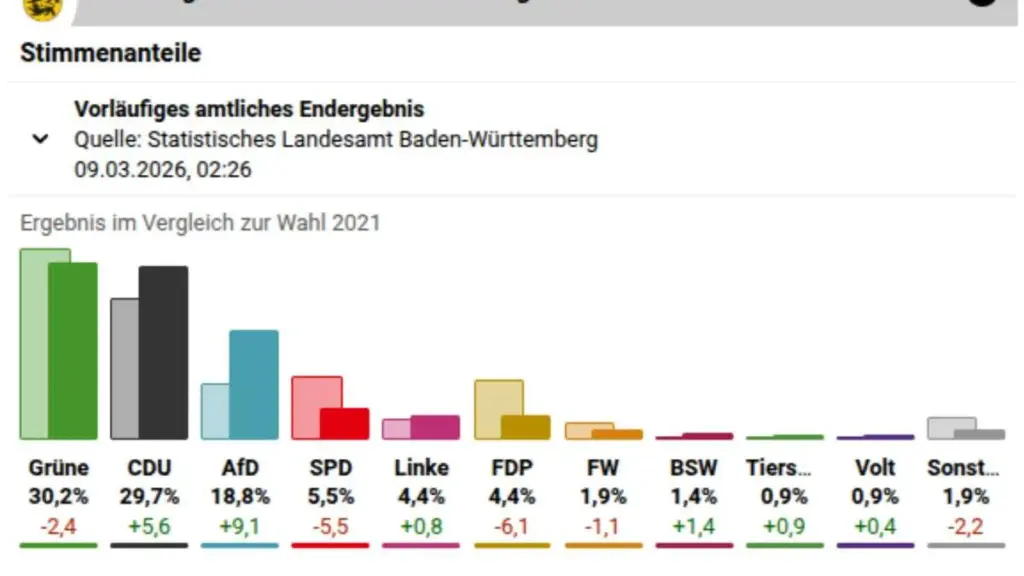
Before the recent developments surrounding Markus Frohnmaier and the Alternative for Germany (AfD), the political landscape in Baden-Württemberg was characterized by a relatively stable dominance of traditional parties. The AfD had garnered only 9.7% of the votes in the 2021 state election, positioning it as a minor player in the regional political arena. This was a time when the party struggled to gain traction against established political forces, and its controversial reputation often overshadowed its electoral ambitions.
Decisive Changes in the 2026 Election
The situation shifted dramatically in the 2026 state election, where the AfD achieved a significant increase in voter support, receiving 18.8% of the votes. This marked a remarkable 9 percentage point increase compared to the previous election. The decisive moment came as Frohnmaier, a Bundestagsabgeordneter since 2017, emerged as the AfD’s candidate for Ministerpräsident, despite not being on the ballot due to his current position. His association with AfD leader Alice Weidel and his controversial background, including connections to Russia, have made him a polarizing figure in the political discourse.
Immediate Effects on Political Dynamics
The immediate effects of this electoral shift have been profound. The AfD is now poised to become the largest opposition party in the Baden-Württemberg parliament, fundamentally altering the dynamics of regional governance. Frohnmaier’s offer of cooperation to CDU leader Manuel Hagel indicates a willingness to engage with traditional parties, although Hagel has publicly stated that he would not accept votes from the AfD to secure his position. This tension highlights the complexities of navigating a political landscape increasingly influenced by right-wing populism.
Expert Perspectives on the Shift
Political analysts are closely monitoring the implications of the AfD’s rise in Baden-Württemberg. Cem Özdemir, a prominent figure in the region, has articulated a clear stance against the AfD, emphasizing the need to ensure that the party does not gain further strength in future elections. His assertion that the government’s mandate should focus on reducing the AfD’s influence underscores the challenges faced by traditional parties in countering the growing appeal of right-wing extremism, as classified by the Baden-Württemberg state constitution protection.
Frohnmaier’s Controversial Background
Markus Frohnmaier’s background adds another layer of complexity to his political narrative. Born in Romania and adopted by a German couple, he has been a member of the Bundestag since 2017. His controversial connections to Russia and right-wing groups have raised concerns among critics, who argue that such affiliations could undermine democratic values in the region. The AfD’s classification as a right-wing extremist suspect further complicates Frohnmaier’s position and the party’s legitimacy.
Future Implications for the AfD
As the AfD consolidates its position as a significant force in Baden-Württemberg, the implications for future elections are substantial. Alice Weidel’s satisfaction with the election results reflects a growing confidence within the party, which may embolden them to pursue more aggressive political strategies. The potential for increased collaboration or confrontation with traditional parties will shape the region’s political landscape in the coming years.
The rise of Markus Frohnmaier and the AfD in Baden-Württemberg marks a critical juncture in the region’s political history. With a notable increase in voter support and a shift in opposition dynamics, the future of governance in Baden-Württemberg appears increasingly contentious. As political leaders navigate this new reality, the ongoing discourse surrounding the AfD’s role will be pivotal in determining the trajectory of the region’s political landscape.