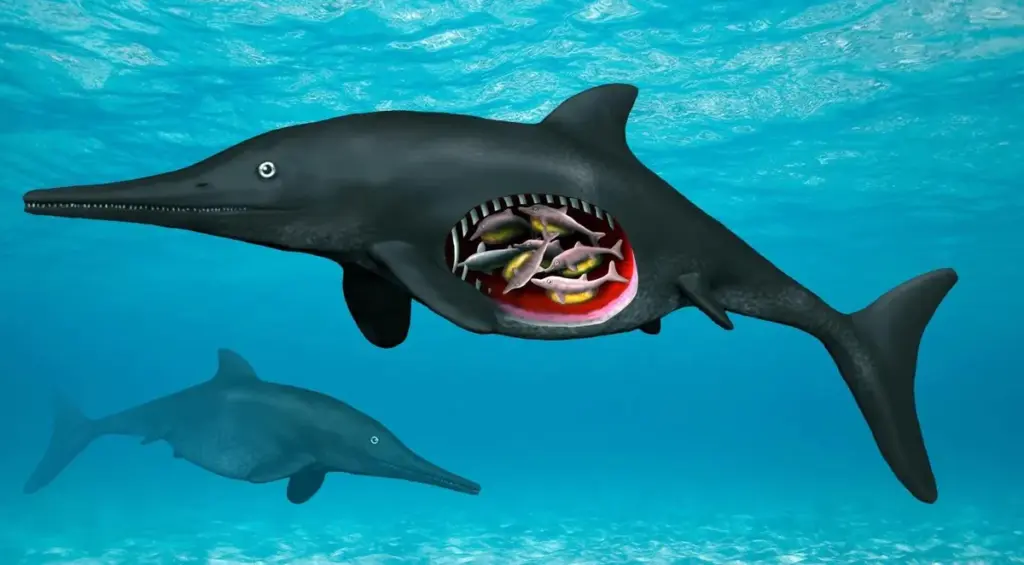
A newly discovered ichthyosaur fossil from Germany offers insights into prehistoric survival and marine ecosystems during the Jurassic period.
The recent discovery of a 180-million-year-old ichthyosaur fossil in Mistelgau, Germany, challenges long-held beliefs about the survival and feeding adaptations of these ancient marine reptiles. The specimen, belonging to the genus Temnodontosaurus, measures approximately 21 feet in length and provides a wealth of information about life during the Jurassic period.
Researchers unearthed this remarkable fossil, which includes a nearly complete skull, lower jaw, shoulder girdle, spine, and over 100 teeth. Notably, it shows signs of severe jaw injuries. This finding raises questions: how did this ichthyosaur manage to survive despite such significant physical limitations? According to Stefan Eggmaier, one of the researchers involved in the study, “The fact that it nevertheless survived is evidenced, among other things, by its heavily worn teeth and gastroliths…”
The presence of gastroliths—stones found in the abdominal cavity—suggests a notable shift in feeding behavior. This adaptation could indicate that the ichthyosaur had to modify its diet due to its injuries. Observers note that this discovery offers crucial insights into the ecological dynamics of Jurassic seas.
That context matters because it helps us understand how marine ecosystems functioned millions of years ago. The ichthyosaur resembles modern-day dolphins but is not directly related to them; rather, it exemplifies convergent evolution, where unrelated species develop similar traits due to similar environmental pressures.
This fossil is one of the youngest finds of the ichthyosaur genus to date. Ulrike Albert, another researcher on the project, stated: “Our Temnodontosaurus fossil is one of the youngest finds of this ichthyosaur genus to date.” This finding challenges previous assumptions about ichthyosaurs’ survival timeline in this region.
The Mistelgau site has been a rich source of marine fossils since excavations began in 1998. With each new discovery like this ichthyosaur, scientists gain deeper insights into prehistoric survival and adaptation strategies within ancient marine ecosystems.
As research continues on this remarkable specimen, further analysis will likely reveal more about how these creatures navigated their environments despite physical challenges. The findings were detailed in the Journal Zitteliana and are expected to spark new discussions regarding fossil preservation and evolutionary biology.